Edit: This will take place of Tuesday Terrors this week
Figured I'd throw this one out there before -everyone- had already heard about it. My mom sent me this article the other day, most other article pretty much say the same thing:
As if whitetail Does needed anything else to be paranoid about...
The fact that this happened doesn't surprise me really. The snakes are everywhere down there and I'm sure this isn't the first time it's happened...It's just the first time we've seen it. For anyone that doesn't know, the Burmese Python (along with thousands of other exotics and invasives) is running loose in South Florida, particularly the Everglades which is most similar to its natural habitat.
The snakes got into the wild via the exotic pet trade. They simply get too big (up to 20ft) and some people didn't want them anymore and let them go. What resulted was the release of an invasive super predator in the Everglades. The Burmese Python will eat just about anything that it can fit in its mouth and many biologists fear it poses a serious problem for threatened or endangered bird or small mammal species.
During a wildlife techniques course that I took, we were asked to design a poster presentation to help solve a wildlife technique problem. I chose, "Capture methods of the Burmese Python in the Florida Everglades". The issue right now, is that the snakes are -extremely- difficult to find. The Everglades literally is "a river of grass" and finding them is quite the challenge in the high grass. Baited traps don't particularly work because the snakes prefer live prey (just imagine the flak someone would catch for live baiting a trap with a cat or something). Funnel traps might work, but then you're just hoping the snake slithers by and falls in. Scent dogs have the possibility to work, but most of the snake's time is spent in the water, making trailing by a dog very difficult. Right now, the two most common methods that I've heard of are these: Drive along a road at night and look for them crossing the road. And radio tagging adult females and re-releasing them into the wild. Re-releasing actually seems to be a more effective method. This is because when the snakes breed, a female can draw multiple males two her and they have this giant, breeding, snake-ball thing going on. Using radio telemetry, biologists can just locate the female, and dispose of all snakes present around her.
I, of course, made up a beautiful poster for wildlife techniques, presented it flawlessly to the class, and awaited my grade.
80%...B -. Little did I know, that my professor was actually called down to South Florida to be on the conference board to help solve the Burmese Python problem. He said essentially what I said which was "there's no good way to catch them". And I guess since he obviously knew a bit more about the situation than I did, he felt my presentation was lacking.
Hopefully we find a solution soon. Their spread north continues, though I question exactly how far north they can spread due to freezing winters. I personally think they should just put a 100$ bounty on each snake's head, let people take an snake identification test, and if they pass, give them a license and the go-ahead to kill as many as they can find.
Couldn't hurt...
Showing posts with label Tuesday Terrors. Show all posts
Sunday, October 30, 2011
Wednesday, October 26, 2011
Tuesday Terrors: Bees and Wasps
As I stood there in Austin Cary Memorial Forest, trying to remember the scientific name of Fetterbush for a Forest Ecology class, something kept buzzing around my head. My group members were all in a similar situation, standing waist deep in Saw Palmettos and blackberry briers, and trying to recall scientific names. The buzzing continued around my head until I finally noticed a Yellow Jacket trying to land on my chest.
You stupid...get away...gah...dumb thing, are the usual thoughts as one tries in vain to shoo away a wasp. The key word here is A wasp. Just one.
The following sting on the knuckle and emergence of a swarming Hymenopteran death cloud resulted in a slightly different response. The string of expletives that followed could make a drunken pirate blush. To add, my thrashing and near teleportation from the area sent my Forest Ecology group running out of the woods like a live mortar round had just landed nearby.
Yes, for the second time within a year, I'd found a Yellow Jacket nest. They nest in the ground and I managed to stand right on top of it. Luckily (I guess), I was the only person who'd been stung. We soon picked a new area to do our survey, and I used some ice I still had in a cup to help with the swelling on my knuckle. Also, I didn't get stung as badly as I did over the summer. That resulted in several nasty stings and me running a few hundred yards before I finally escaped.
Getting stung can obviously be avoided. It's just important to watch where you're going and what you're doing. I thank God that I'm not allergic to them. One of the guys in my Forest Ecology group is allergic and had -he- been the one to step on the nest, the outcome would have been much more serious.
I realized that I literally have -no- photos of bees or wasps. They're generally something I don't hang out around very often, and certainly not long enough to snap a picture. I'm certain I'll run into plenty more in the future, but I hope they're one at a time. Two nests within one year are two too many.
You stupid...get away...gah...dumb thing, are the usual thoughts as one tries in vain to shoo away a wasp. The key word here is A wasp. Just one.
| Photo taken from entnemdept.ufl.edu |
The following sting on the knuckle and emergence of a swarming Hymenopteran death cloud resulted in a slightly different response. The string of expletives that followed could make a drunken pirate blush. To add, my thrashing and near teleportation from the area sent my Forest Ecology group running out of the woods like a live mortar round had just landed nearby.
Yes, for the second time within a year, I'd found a Yellow Jacket nest. They nest in the ground and I managed to stand right on top of it. Luckily (I guess), I was the only person who'd been stung. We soon picked a new area to do our survey, and I used some ice I still had in a cup to help with the swelling on my knuckle. Also, I didn't get stung as badly as I did over the summer. That resulted in several nasty stings and me running a few hundred yards before I finally escaped.
Getting stung can obviously be avoided. It's just important to watch where you're going and what you're doing. I thank God that I'm not allergic to them. One of the guys in my Forest Ecology group is allergic and had -he- been the one to step on the nest, the outcome would have been much more serious.
I realized that I literally have -no- photos of bees or wasps. They're generally something I don't hang out around very often, and certainly not long enough to snap a picture. I'm certain I'll run into plenty more in the future, but I hope they're one at a time. Two nests within one year are two too many.
Wednesday, October 12, 2011
Tuesday Terrors: American Crocodile
So there I was today, fresh out of my Practical Plant Taxonomy mid-term and getting ready to go hunt. All my gear was lined up: Bow, tree stand, back pack, fishing rod, and cooler. I planned to spend the whole rest of the day out in the woods.
Until I face planted in my bed and slept for four and a half hours.
Once I finally snapped out of my coma, I really wanted to be in my stand. However, the last thing I wanted to do was fill up the Jeep with gas, drive out to the woods, and haul all my gear to the back of the swamp...Then back out. So instead of going hunting/fishing today, I sat on my butt and played video games and relaxed for the first time in almost two weeks. I'll chase deer and catfish Thursday.
I didn't forget Tuesday Terrors though (even if I am writing this at 12:30 am Wednesday morning).
This week's Tuesday Terror is the American Crocodile. A surprisingly large amount of people are unaware of the fact that the US does, in fact, have crocodiles. The most common thing I hear is someone calling an Alligator, a crocodile.
They are two completely different species and Florida is the only state in the US that has Crocodiles. However, their range is extremely restricted. I certainly won't be walking along the beach in Pensacola and run into one...Unless of course it escaped from the zoo.
The American Crocodile is restricted to the Everglades and 10,000 Islands region in South-Southeast Florida. It ventures into saltwater a bit more frequently than Alligators and primarily inhabits the Mangrove swamps in this region of the state. Mention a true Saltwater Crocodile and many people envision Steve Irwin wrangling a ferocious Croc in his khakis. The American Crocodile is actually a different species and thank God. They aren't nearly as aggressive as the Saltwater Crocodile located in places such as Australia. To give you an idea of the aggressiveness of those guys, I heard this story on the radio and found a couple of reports online.
http://www.efarming.com.au/News/general/26/04/2011/136930/crocodile-attacks-fisherman-in-boat.html
http://www.dailytelegraph.com.au/news/croc-lands-in-fishermans-boat-and-attacks-in-nt/story-e6freuy9-1226045044470
Apparently the Croc jumped out of the water, and snatched a fisherman up to his shoulder WHILE HE WAS IN THE BOAT.
You can scratch "Kayak fish in Australia" off my Bucket List...Unless of course, I've already reached the end of my Bucket List.
The American Crocodile is apparently a little more...Chill (Though it's not something to go hug). There are a couple of key identifying features that one can use to distinguish omnipresent Alligator from the American Crocodile. I think the most obvious feature are their teeth. When an Alligator has its mouth closed, most of its teeth aren't visible. When the American Crocodile, on the other hand, has its mouth closed, almost all of its razor sharp teeth are visibly sticking out. Another key feature is the snout shape. Gators have blunt, rounded snouts. Crocodiles have very long, almost pointed snouts.
Finally, the scales on a Crocodile's back can give it away. Unlike the a Gator's back which is kinda lumpy and the spikes on the tail aren't all that sharp, the Croc has near spikes sticking from its back and tail.
I of course, had only read these things for some of my classes like Wildlife of Florida. Given a bleach white skull on a lab desk, I could tell you the difference between a Croc and a Gator. But last spring I got a chance to see one of these American Crocodiles in the wild, and it was obvious it was a Croc.
While on a kayak fishing trip in the Everglades last February, I paddled into a small pond to start casting around. Immediately upon entering the pond, I noticed what looked like a giant gray pile of dirt on the far end. As I got closer, I realized that it wasn't a pile of dirt, but rather a Gator. A HUGE gator. I then did the only logical thing to do in such a situation...
I paddled closer.
Once I got within about 60 yards of the living dinosaur, I realized that it wasn't an Alligator. It was 100% an American Crocodile. Visible teeth on the outside of the mouth, huge sharp tail spikes, and a narrow snout. He was also gargantuan. I paddle a 16 foot kayak and I certainly didn't feel like the longest thing in the pond.
Even laying on his stomach, the Croc's back came a good 2 1/2 foot high. I then snapped a few pictures, and decided to be on my way before it decided to move off the bank. It was a pretty cold day, so I doubt he really felt like moving, but I didn't want to push my luck.
I did a quick search to see whether or not there had been any documented attacks by American Crocodiles in the US. Though I did find many in Mexico, and some South American countries, I couldn't find anything about attacks in the US. That certainly doesn't mean it can't happen. It just means it hasn't happened yet. With conservation awareness growing for the species, and human population/expansion on the rise, an attack on a human in the coming years wouldn't surprise me in the least.
If you're ever lucky enough to see one, just remember to give it space. Please don't EVER feed one and have it start associating humans with food. And I wouldn't advise swimming near it. Other than that, you should be well prepared to encounter one.
Oh, and never go kayak fish in Australia.
I've still got quite a bit of catching up to do with my reports, so hopefully I can knock those out later this week. And if you haven't done so already, please vote in the poll on the upper right side of the web page. Stay tuned!
Until I face planted in my bed and slept for four and a half hours.
Once I finally snapped out of my coma, I really wanted to be in my stand. However, the last thing I wanted to do was fill up the Jeep with gas, drive out to the woods, and haul all my gear to the back of the swamp...Then back out. So instead of going hunting/fishing today, I sat on my butt and played video games and relaxed for the first time in almost two weeks. I'll chase deer and catfish Thursday.
I didn't forget Tuesday Terrors though (even if I am writing this at 12:30 am Wednesday morning).
This week's Tuesday Terror is the American Crocodile. A surprisingly large amount of people are unaware of the fact that the US does, in fact, have crocodiles. The most common thing I hear is someone calling an Alligator, a crocodile.
| Gator in the Glades |
| Map taken from nationalgeographic.co.uk |
http://www.efarming.com.au/News/general/26/04/2011/136930/crocodile-attacks-fisherman-in-boat.html
http://www.dailytelegraph.com.au/news/croc-lands-in-fishermans-boat-and-attacks-in-nt/story-e6freuy9-1226045044470
Apparently the Croc jumped out of the water, and snatched a fisherman up to his shoulder WHILE HE WAS IN THE BOAT.
You can scratch "Kayak fish in Australia" off my Bucket List...Unless of course, I've already reached the end of my Bucket List.
The American Crocodile is apparently a little more...Chill (Though it's not something to go hug). There are a couple of key identifying features that one can use to distinguish omnipresent Alligator from the American Crocodile. I think the most obvious feature are their teeth. When an Alligator has its mouth closed, most of its teeth aren't visible. When the American Crocodile, on the other hand, has its mouth closed, almost all of its razor sharp teeth are visibly sticking out. Another key feature is the snout shape. Gators have blunt, rounded snouts. Crocodiles have very long, almost pointed snouts.
| Photo taken from scienceray.com |
Finally, the scales on a Crocodile's back can give it away. Unlike the a Gator's back which is kinda lumpy and the spikes on the tail aren't all that sharp, the Croc has near spikes sticking from its back and tail.
I of course, had only read these things for some of my classes like Wildlife of Florida. Given a bleach white skull on a lab desk, I could tell you the difference between a Croc and a Gator. But last spring I got a chance to see one of these American Crocodiles in the wild, and it was obvious it was a Croc.
While on a kayak fishing trip in the Everglades last February, I paddled into a small pond to start casting around. Immediately upon entering the pond, I noticed what looked like a giant gray pile of dirt on the far end. As I got closer, I realized that it wasn't a pile of dirt, but rather a Gator. A HUGE gator. I then did the only logical thing to do in such a situation...
I paddled closer.
Once I got within about 60 yards of the living dinosaur, I realized that it wasn't an Alligator. It was 100% an American Crocodile. Visible teeth on the outside of the mouth, huge sharp tail spikes, and a narrow snout. He was also gargantuan. I paddle a 16 foot kayak and I certainly didn't feel like the longest thing in the pond.
![]() |
| American Crocodile while on a kayak fishing trip |
Even laying on his stomach, the Croc's back came a good 2 1/2 foot high. I then snapped a few pictures, and decided to be on my way before it decided to move off the bank. It was a pretty cold day, so I doubt he really felt like moving, but I didn't want to push my luck.
I did a quick search to see whether or not there had been any documented attacks by American Crocodiles in the US. Though I did find many in Mexico, and some South American countries, I couldn't find anything about attacks in the US. That certainly doesn't mean it can't happen. It just means it hasn't happened yet. With conservation awareness growing for the species, and human population/expansion on the rise, an attack on a human in the coming years wouldn't surprise me in the least.
If you're ever lucky enough to see one, just remember to give it space. Please don't EVER feed one and have it start associating humans with food. And I wouldn't advise swimming near it. Other than that, you should be well prepared to encounter one.
Oh, and never go kayak fish in Australia.
I've still got quite a bit of catching up to do with my reports, so hopefully I can knock those out later this week. And if you haven't done so already, please vote in the poll on the upper right side of the web page. Stay tuned!
Wednesday, September 28, 2011
Tuesday Terrors: Lightning
As I sat in my tree stand this afternoon, wondering what this week's Tuesday Terror would be, I watched (and listened as) a big thunderstorm rumble across the horizon. To my right was a pine tree quite similar to the one I was sitting in. The only difference was the giant inner-wood crack that ran from crown to roots. It had obviously been zapped by mother nature recently. After seeing all of this, it was clear what today's terror would be...Lightning.
According to national geographic (and about a billion other sources), Florida is the lightning strike capital of the US. Over 1500 lightning strike deaths have occurred in this state alone. Why? Might you ask...
Well, take today for example. My first hunt of the 2011 archery season and I nearly keeled over from the heat. I'm not usually one to complain about it being too hot for anything, but...today was too hot. I was drenched before I even got out of the Jeep. To add, it was so humid I could see the steam rising off the dirt road. This heat generates afternoon storms like crazy and it's these storms that produce so much lightning.
Now, I took a meteorology class a few years back...but I honestly can't remember what they tried to teach me about lightning aside from the fact that strikes apparently occur from the ground up and what we see is the electricity going back up. There was some other crazy stuff they tried to teach me, but my brain exploded while trying to wrap it around the concepts. All I know is that it likes to strike the highest point nearby...and it'll kill you. That's enough for me.
Florida probably leads the country in deaths not only because of it's weather, but because some of our favorite outdoor activities involve sitting in trees, sitting in boats, or swinging clubs at little white balls. All of these activities (or any outdoor activity to be fair) makes one vulnerable to lightning should there be a storm nearby.
I had my close call with lightning two summers back. While pulling in a stringer from a canal in south Florida, a bolt struck the water nearby and shocked me up to my elbows. That was more than enough to make me extremely wary of lightning from now on.
Just try and be smart about it. Don't go stand in some field when a storm's nearby, or find shelter under the tallest tree. Seek some low-lying place and make yourself as short as possible if you're stuck outside. Otherwise, get inside...or at least in a car.
Even though lightning can be something beautiful to look at from a distance, it's something you just don't play around with up close. It's kinda light Russian-Roulette with mother nature...There's no telling where the next strike will land.
Should have a report from my hunting trip coming out later this week. Rutting deer already? Bird-like dragonflies? Stay tuned!
| Photo taken from swfwmd.state.fl.us |
According to national geographic (and about a billion other sources), Florida is the lightning strike capital of the US. Over 1500 lightning strike deaths have occurred in this state alone. Why? Might you ask...
Well, take today for example. My first hunt of the 2011 archery season and I nearly keeled over from the heat. I'm not usually one to complain about it being too hot for anything, but...today was too hot. I was drenched before I even got out of the Jeep. To add, it was so humid I could see the steam rising off the dirt road. This heat generates afternoon storms like crazy and it's these storms that produce so much lightning.
Now, I took a meteorology class a few years back...but I honestly can't remember what they tried to teach me about lightning aside from the fact that strikes apparently occur from the ground up and what we see is the electricity going back up. There was some other crazy stuff they tried to teach me, but my brain exploded while trying to wrap it around the concepts. All I know is that it likes to strike the highest point nearby...and it'll kill you. That's enough for me.
Florida probably leads the country in deaths not only because of it's weather, but because some of our favorite outdoor activities involve sitting in trees, sitting in boats, or swinging clubs at little white balls. All of these activities (or any outdoor activity to be fair) makes one vulnerable to lightning should there be a storm nearby.
I had my close call with lightning two summers back. While pulling in a stringer from a canal in south Florida, a bolt struck the water nearby and shocked me up to my elbows. That was more than enough to make me extremely wary of lightning from now on.
Just try and be smart about it. Don't go stand in some field when a storm's nearby, or find shelter under the tallest tree. Seek some low-lying place and make yourself as short as possible if you're stuck outside. Otherwise, get inside...or at least in a car.
Even though lightning can be something beautiful to look at from a distance, it's something you just don't play around with up close. It's kinda light Russian-Roulette with mother nature...There's no telling where the next strike will land.
![]() |
| Lightning at night during my internship |
Should have a report from my hunting trip coming out later this week. Rutting deer already? Bird-like dragonflies? Stay tuned!
Wednesday, September 14, 2011
Tuesday Terrors: Florida Walking Sticks
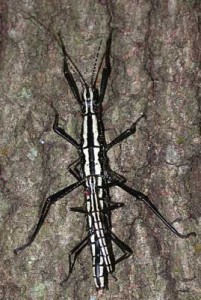
This week's Tuesday Terror is the Florida Walking Stick, or Two Lined walking stick.
-Wait. Like a bug kinda walking stick?
-Yes, that kind of walking stick.
-But I thought Tuesday Terrors were...You know...Dangerous.
-That's correct...
Though it may not be the most obvious of Florida's dangers, it still poses a threat if directly encountered. And by directly encountering...I mean picking it up to look at it.
My first encounter with a Florida Walking Stick was outside of Pensacola Junior College when I was still getting my associates. A male and female were together and had failed miserably at resembling a stick by attempting to hide on the library's brick wall. My initial reaction to the insect was something along the lines of:
"Oh dear God what is that".
I certainly didn't pick it up, or touch it even. My limit of research was to google 'walking sticks in Florida' and up popped the picture of the Florida Walking Stick.
I didn't realize the danger in these insects until I took an entomology course at the University of Florida. For our grade, we needed to have an insect collection of approximately 50 bugs. My dad was down visiting and we went to look for shark's teeth in a nearby creek. Since I needed my collection, and was going in the woods anyways, I took my kill jar with us. While walking across a boardwalk, I spotted something on a post. The Florida Walking Stick!
I really didn't want to pick it up. Again, it had a male attached to its back and was busy making little walking sticks. I tried my best to coax it into the kill jar, but was failing. My dad finally said something along the lines of "Don't be such a wimp", but manlier and with more expletives. He then proceeded to grab the bug. What happened next was the -exact- reason why I just don't go picking things up.
The insect immediately squirted a white milky substance all over my dad's hand. It stank to high heaven and was apparently slippery as it fell right out of his hand. After a few disgusting moments of trying to catch a now slippery and foul smelling creature, we finally managed to get it into the kill jar. It really did smell terrible, and my dad went down to the creek to wash his hands off.
A few days later, I did a bit more research on this bug. Remember that white milky stuff? Turns out if you get it in your eyes, it'll cause symptoms anywhere from pain to temporary blindness. The pain was described as having a hot iron shoved into the eye socket.
http://bugguide.net/node/view/43491/bgimage
http://www.whatsthatbug.com/2003/10/06/two-lined-walkingstick-anisomorpha-buprestoides/
So there you have it. Another little something to -not- mess with. Kinda makes me glad they prefer hide rather than charge right at you.
Should have some pictures and the report from the Cedar Key trip later this week. Tailing Redfish? Tailing Black Drum? 40lbs Black Drum while kayak fishing? Stay tuned!
| Photo taken from Pestcemetary.com |
-Wait. Like a bug kinda walking stick?
-Yes, that kind of walking stick.
-But I thought Tuesday Terrors were...You know...Dangerous.
-That's correct...
Though it may not be the most obvious of Florida's dangers, it still poses a threat if directly encountered. And by directly encountering...I mean picking it up to look at it.
My first encounter with a Florida Walking Stick was outside of Pensacola Junior College when I was still getting my associates. A male and female were together and had failed miserably at resembling a stick by attempting to hide on the library's brick wall. My initial reaction to the insect was something along the lines of:
"Oh dear God what is that".
I certainly didn't pick it up, or touch it even. My limit of research was to google 'walking sticks in Florida' and up popped the picture of the Florida Walking Stick.
I didn't realize the danger in these insects until I took an entomology course at the University of Florida. For our grade, we needed to have an insect collection of approximately 50 bugs. My dad was down visiting and we went to look for shark's teeth in a nearby creek. Since I needed my collection, and was going in the woods anyways, I took my kill jar with us. While walking across a boardwalk, I spotted something on a post. The Florida Walking Stick!
I really didn't want to pick it up. Again, it had a male attached to its back and was busy making little walking sticks. I tried my best to coax it into the kill jar, but was failing. My dad finally said something along the lines of "Don't be such a wimp", but manlier and with more expletives. He then proceeded to grab the bug. What happened next was the -exact- reason why I just don't go picking things up.
The insect immediately squirted a white milky substance all over my dad's hand. It stank to high heaven and was apparently slippery as it fell right out of his hand. After a few disgusting moments of trying to catch a now slippery and foul smelling creature, we finally managed to get it into the kill jar. It really did smell terrible, and my dad went down to the creek to wash his hands off.
A few days later, I did a bit more research on this bug. Remember that white milky stuff? Turns out if you get it in your eyes, it'll cause symptoms anywhere from pain to temporary blindness. The pain was described as having a hot iron shoved into the eye socket.
http://bugguide.net/node/view/43491/bgimage
http://www.whatsthatbug.com/2003/10/06/two-lined-walkingstick-anisomorpha-buprestoides/
So there you have it. Another little something to -not- mess with. Kinda makes me glad they prefer hide rather than charge right at you.
Should have some pictures and the report from the Cedar Key trip later this week. Tailing Redfish? Tailing Black Drum? 40lbs Black Drum while kayak fishing? Stay tuned!
Wednesday, September 7, 2011
Tuesday Terrors: Rattlesnakes
Recently I've been looking for things that I can post on a weekly basis. Since I'm not fishing every week now, and hunting season is still a couple of weeks away, I can try this out to fill up the time. Hopefully, I'll have something to post every Tuesday for Tuesday Terrors.
The focus of Tuesday Terrors will be things in the Florida outdoors that can hurt/kill you. Each week will feature a new subject. Some (like this week) are obviously dangerous, while others may be overlooked or forgotten at times. And not all things are found -only- in Florida, but some. The purpose is to try and gather all the different dangerous things in order to be more aware...or maybe paranoid.
So with that, I give you the first installment of Tuesday Terrors.
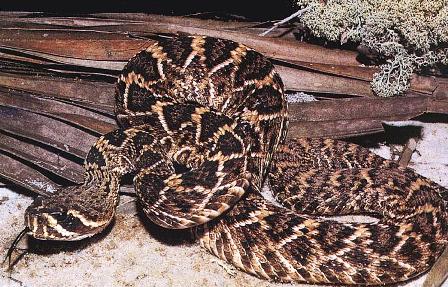
With hunting season right around the corner, more and more people will be venturing into the woods to begin scouting. Aside from the heat and mosquitoes, there's another thing one must be especially careful to watch out for: Rattlesnakes.
With it still being so hot and humid outside, the Rattlesnakes are out in full force. Even though they may not be as much of a threat later in the season when it's ungodly cold out, they're certainly something to watch out for in the preseason and early archery season.
I've encountered Rattlesnakes in just about all forms of habitat in Florida. But, if I had to select a few that they tend to hang out in, it would be grassy areas such as sandhills or old fields. I'd also watch my step in areas with thick saw palmetto cover. Areas with lots of Gopher tortoise holes seem to hold a population of rattlesnakes as well. It could be due to the presence of prey that use the holes, or even the holes themselves to stay cool in mid-day and warm in the winter.
Last summer I encountered several Rattlesnakes while prescribed burning and even a few while just walking around. And it's not just the big ones that you have to watch out for. I found this Pygmy Rattler crawling on my foot while I was finishing some photo-points.
Luckily he never got aggressive, and I was able to safely change my pants soon afterwards.
Snake chaps or snake proof boots are a good idea this early in the season. Yes they may be hot, yes they may be uncomfortable, but in my opinion, I'd rather be hot and uncomfortable than get bit.
I've had this pair of snake boots for quite some time now. They certainly give me a sense of security, but I've yet to be unlucky enough to test out their 'snake proof-ness'. I suppose if one was to get bit, my suggestion is to stay as calm as possible. I imagine that a rushing heart rate only helps to spread the venom faster. After you've shot the snake several hundred times (that's at least -my- next step), get to a hospital ASAP. I'm no doctor, but I've seen the pictures of people who've been snake bit and it's not pretty.
Overall, I'd just suggest to watch where you step, especially in places that look like they'd hold snakes. Wear snake boots or snake chaps, and generally just be careful. Even though they'll sometimes rattle at you to warn you not to get any closer, it's hard to run away on jello legs while your heart's in your throat.
Hope ya'll enjoyed my first try and Tuesday Terrors. There's -plenty- more to come (not to worry, I haven't forgotten about the other horrible snakes), and they'll get better...I promise.
The focus of Tuesday Terrors will be things in the Florida outdoors that can hurt/kill you. Each week will feature a new subject. Some (like this week) are obviously dangerous, while others may be overlooked or forgotten at times. And not all things are found -only- in Florida, but some. The purpose is to try and gather all the different dangerous things in order to be more aware...or maybe paranoid.
So with that, I give you the first installment of Tuesday Terrors.
With hunting season right around the corner, more and more people will be venturing into the woods to begin scouting. Aside from the heat and mosquitoes, there's another thing one must be especially careful to watch out for: Rattlesnakes.
| Photo taken from Floridiannature.com |
I've encountered Rattlesnakes in just about all forms of habitat in Florida. But, if I had to select a few that they tend to hang out in, it would be grassy areas such as sandhills or old fields. I'd also watch my step in areas with thick saw palmetto cover. Areas with lots of Gopher tortoise holes seem to hold a population of rattlesnakes as well. It could be due to the presence of prey that use the holes, or even the holes themselves to stay cool in mid-day and warm in the winter.
| Gopher Tortoise hole |
Luckily he never got aggressive, and I was able to safely change my pants soon afterwards.
Snake chaps or snake proof boots are a good idea this early in the season. Yes they may be hot, yes they may be uncomfortable, but in my opinion, I'd rather be hot and uncomfortable than get bit.
I've had this pair of snake boots for quite some time now. They certainly give me a sense of security, but I've yet to be unlucky enough to test out their 'snake proof-ness'. I suppose if one was to get bit, my suggestion is to stay as calm as possible. I imagine that a rushing heart rate only helps to spread the venom faster. After you've shot the snake several hundred times (that's at least -my- next step), get to a hospital ASAP. I'm no doctor, but I've seen the pictures of people who've been snake bit and it's not pretty.
Overall, I'd just suggest to watch where you step, especially in places that look like they'd hold snakes. Wear snake boots or snake chaps, and generally just be careful. Even though they'll sometimes rattle at you to warn you not to get any closer, it's hard to run away on jello legs while your heart's in your throat.
| Ready to strike |
Hope ya'll enjoyed my first try and Tuesday Terrors. There's -plenty- more to come (not to worry, I haven't forgotten about the other horrible snakes), and they'll get better...I promise.
Subscribe to:
Posts (Atom)